Your workers are complaining that nitrile coatings peel off too fast. This costs you money and forces constant replacements. It makes you question your supplier's quality and reliability.
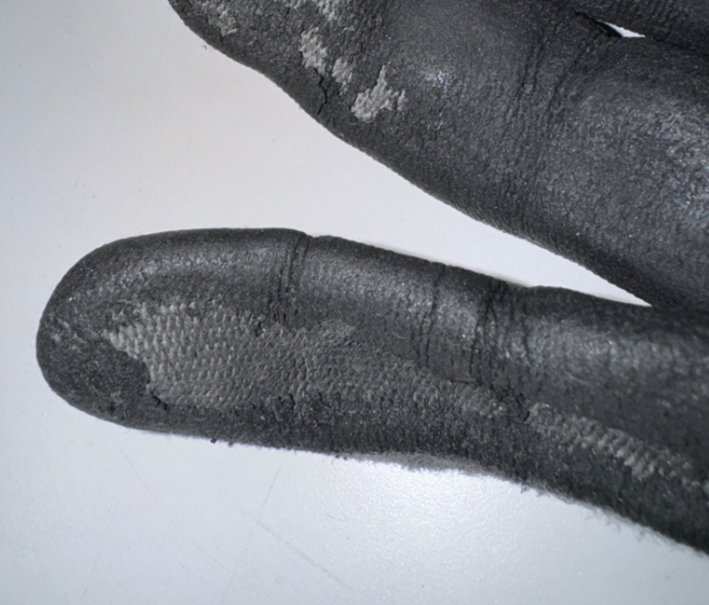
The main reason for peeling is poor adhesion between the coating and the glove liner1. The coating sits on the surface instead of deeply penetrating the liner's gaps2. This can be fixed by adjusting the curing agent3, which allows the coating to bond properly before fully hardening.
This problem was a real challenge for us. It all started when a valued customer came to us with this exact issue. Their experience pushed us to investigate and find a permanent solution. Here is the full story of how we dug deep to find the real cause and fix it for good.
How did a customer complaint reveal why our nitrile coating was peeling off?
A major customer reported a serious problem. Their workers found our gloves were failing after only a day or two. This was a huge concern for us and our client.
Our customer said our A7 micro-foam nitrile gloves lasted only 1-2 days, while a competitor's (MCR) glove lasted 3-5 days. They sent us samples of the failed gloves and the competitor's product. This started our deep investigation into the root cause.
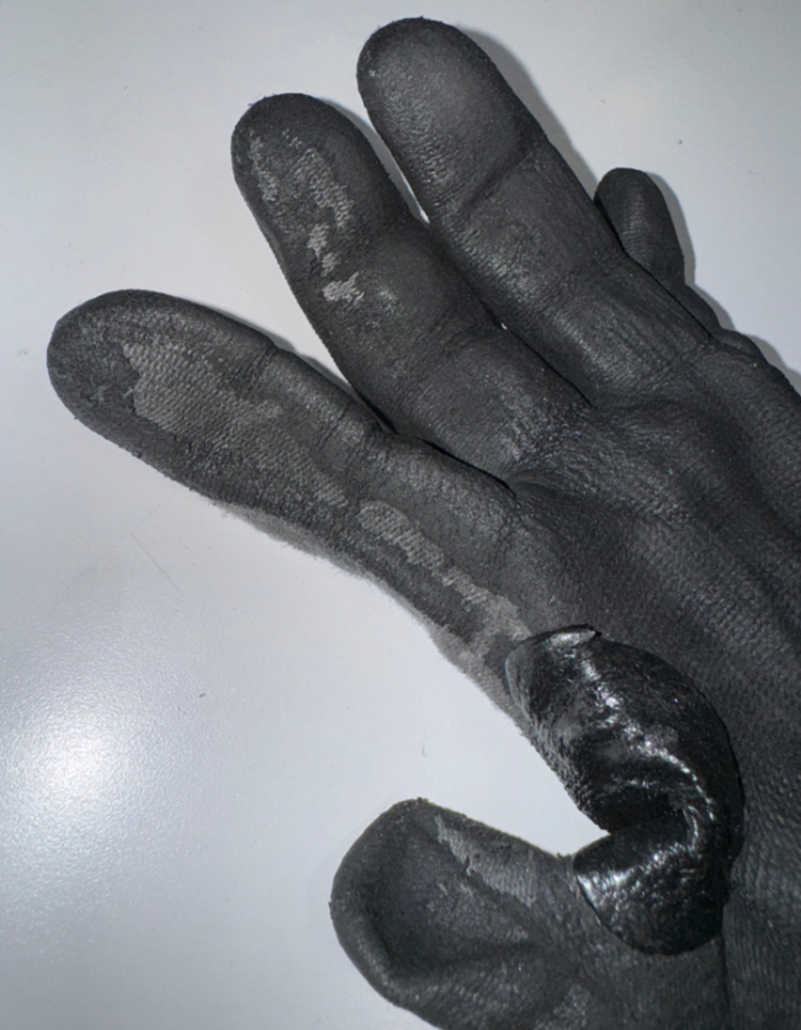
When the complaint first came in, my first thought was to check the basics. I assumed maybe the coating was too thin on the production batch. The customer sent us a few pairs of our gloves with the peeling issue, along with some MCR gloves for comparison. I immediately got out my thickness gauge. I measured the coating thickness on the thumb and index finger of our original trial samples and the bulk production samples. The results were surprising.
Initial Thickness Measurement
| Sample Type | Average Coating Thickness |
|---|---|
| Trial Sample (Approved) | ~1.11 mm |
| Bulk Sample (Failing) | ~1.21 mm |
The bulk sample was actually thicker than the approved trial sample. This meant thickness was not the problem. A thicker coating should theoretically be more durable, not less.4 This told me the issue was more complex. It wasn't about the amount of coating, but the quality of its application. We had to look beyond simple measurements and start testing for performance.
Which tests helped us find the real reason for the peeling coating?
Visual checks and simple measurements were not enough. We needed hard data to understand the durability difference, as guessing the cause would be unprofessional and could lead to the wrong fix.
We decided to perform both EN388 and ANSI abrasion tests5 on our gloves and the competitor's. The results were contradictory at first. But the ANSI test proved to be more aligned with real-world use and ultimately revealed our glove's weakness.
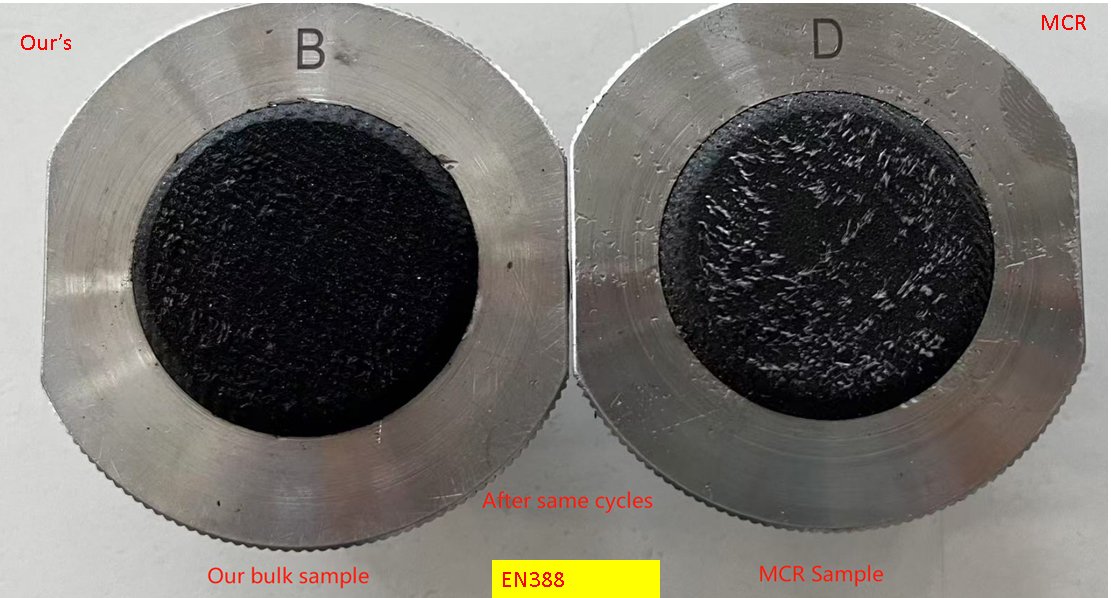
We knew we needed a reliable way to test durability. After checking with the testing agency CTC, we learned that the ANSI abrasion test is the best method to evaluate the durability of both the coating and the liner together6. The standard EN388 abrasion test often just measures how long it takes to rub a hole through the coating.7 The ANSI test, however, uses a rougher wheel and more weight8, which better simulates real-world wear and tear. It shows how well the coating sticks to the liner under stress. So, we sent our bulk samples and the MCR gloves to CTC for official ANSI testing. At the same time, our in-house lab ran EN388 abrasion tests.
Conflicting Test Results: EN388 vs. ANSI
| Test Method | Our Glove Result | MCR Glove Result | Our Interpretation |
|---|---|---|---|
| EN388 Abrasion | More Durable | Less Durable | Our coating resisted surface wear better. |
| ANSI Abrasion | Less Durable | More Durable | MCR's coating had a much stronger bond. |
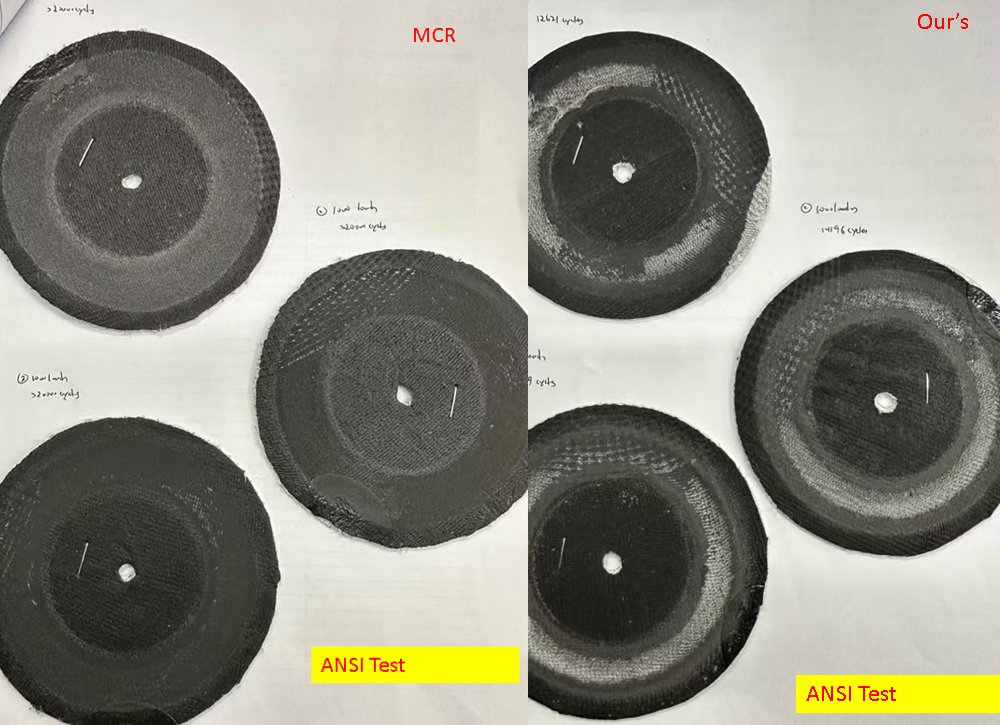
The results were confusing. EN388 showed our glove was better, but ANSI showed it was worse. Since the customer's complaint was about the coating peeling off, not wearing through9, the ANSI test result was much closer to the actual problem. It confirmed that our coating was not adhering to the liner properly.
What really makes a nitrile coating strong and durable?
Knowing our glove was weaker was not enough. We had to understand exactly why it was failing. Without finding the root cause, we could not create a permanent solution for our customer.
True durability comes from a strong bond between the coating and the knitted liner.10 The nitrile foam must penetrate the small gaps in the liner, not just sit on the surface. This critical step is controlled by the curing process during manufacturing11.
The ANSI test results pointed us in the right direction. The coating was peeling off because the adhesion between the nitrile foam and the liner was not good enough. The coating was forming a layer on top of the surface but failing to penetrate and lock into the knitted liner's structure. To solve this, we didn't need a new material, we needed to adjust our process.
The Solution: Modifying the Curing Process
The key was in the curing agent we used in the nitrile compound. The original agent caused the foam to cure too quickly12. It solidified before it had a chance to seep into the tiny gaps between the liner's yarns. We switched to a different curing agent that worked more slowly. This change gave the nitrile foam enough time to penetrate the liner's surface, creating a much stronger mechanical bond. The coating would still cure completely, but only after it had anchored itself firmly into the liner.
We produced one dozen pairs for each size with this new process and sent them to our customer for a field test. Their workers used the gloves and confirmed the peeling issue was gone. The new gloves were just as durable as the competitor's. The samples were approved, and we soon received new repeat orders.
Conclusion
We found that true durability comes from deep coating penetration. By adjusting our process, we solved the peeling issue, delivered a better product, and strengthened our customer's trust.
---"Adhesion and Stability of Nanocellulose Coatings on Flat ...", https://pmc.ncbi.nlm.nih.gov/articles/PMC7397189/. A peer-reviewed study on coated textiles or rubber–fabric composites can support that weak interfacial adhesion commonly causes coating delamination or peeling from a fabric substrate; the evidence would describe the mechanism generally rather than this specific glove batch. Evidence role: mechanism; source type: paper. Supports: The main reason for the nitrile coating peeling is poor adhesion between the coating and the glove liner.. Scope note: Contextual support only, because external literature cannot verify the article's specific production failure. ↩
"3D Printing onto Textiles: A Systematic Analysis of the Adhesion ...", https://pmc.ncbi.nlm.nih.gov/articles/PMC11057686/. Research on polymer-coated or impregnated textiles can support that penetration into yarn interstices promotes mechanical interlocking between coating and fabric; it does not by itself prove the exact penetration depth needed for micro-foam nitrile gloves. Evidence role: mechanism; source type: paper. Supports: A nitrile coating that penetrates the liner's gaps adheres better than one that remains only on the surface.. Scope note: The support is likely about coated textiles or rubber–fabric composites generally, not the exact glove construction discussed. ↩
"Adhesion property of crosslinked epoxidized (natural rubber ... - HERO", https://hero.epa.gov/reference/4726093/. Polymer and rubber curing literature can support that curing agents and cure kinetics affect crosslinking rate, viscosity development, and adhesion to substrates; this is mechanistic support and not direct evidence that the author's chosen curing agent fixed the field complaint. Evidence role: mechanism; source type: paper. Supports: Changing the curing agent can alter the curing behavior of nitrile compound and improve bonding before full hardening.. Scope note: External sources can support the curing principle, but not the article's specific proprietary formulation change. ↩
"Research on the Durability and Reliability of Industrial Layered ...", https://pmc.ncbi.nlm.nih.gov/articles/PMC10004672/. Abrasion and coating-performance literature can support that coating thickness may influence wear life, while durability also depends on adhesion and material properties; the source would qualify rather than fully prove the article's expectation. Evidence role: general_support; source type: paper. Supports: Coating thickness can affect durability, but greater thickness alone does not rule out failure caused by poor adhesion or process quality.. Scope note: Thickness is only one factor in durability, so the evidence should not be used to imply that thicker coatings are always more durable. ↩
"EN 388 Standard for Protective Gloves Against Mechanical ...", https://us.pipglobal.com/en/updated-en-388-standard/. Official standards descriptions can support that EN 388 and ANSI/ISEA 105 are recognized standards used to classify abrasion resistance of protective gloves; the citation would not validate the article's individual test results. Evidence role: definition; source type: institution. Supports: EN388 and ANSI abrasion tests are relevant standardized methods for assessing abrasion resistance in protective gloves.. Scope note: Standards sources establish the purpose of the tests, not the accuracy of the author's reported comparison. ↩
"Safety glove certification series: Understanding abrasion resistance", https://www.hexarmor.com/posts/understanding-abrasion-resistance. ANSI/ISEA 105 documentation can support that its abrasion-resistance classification is designed for hand-protection materials and is commonly tied to standardized rotary abrasion methods; it would not establish that ANSI is universally the 'best' method for all glove durability questions. Evidence role: expert_consensus; source type: institution. Supports: The ANSI abrasion method can be an appropriate standardized way to evaluate abrasion durability of glove materials, including coated constructions.. Scope note: The word 'best' is comparative and context-dependent; a standards source can support appropriateness, not universal superiority. ↩
"EN 388:2016+A1:2018 | ATG® Intelligent Glove Solutions", https://www.atg-glovesolutions.com/en/legal/standards/en-3882016a12018. EN 388 test descriptions can support that abrasion resistance is classified by the number of cycles to breakthrough under prescribed conditions; the source may not use the article's informal wording about 'just' measuring coating wear-through. Evidence role: definition; source type: institution. Supports: EN 388 abrasion testing measures abrasion cycles to breakthrough or hole formation under specified conditions.. Scope note: The standard defines a controlled laboratory endpoint and should not be reduced to the only possible interpretation of EN 388 performance. ↩
"ANSI Abrasion - Bob Dale Gloves (BDG)", https://www.bobdalegloves.com/resources/rating-standards/ansi-abrasion/. ANSI/ISEA 105 and the referenced ASTM abrasion methods can support the specified abrading wheel and load used for glove abrasion classification; comparison with EN 388 requires consulting both standards because test apparatus and conditions differ. Evidence role: definition; source type: institution. Supports: The ANSI abrasion test uses specified rotary abrasion equipment, wheel type, and load that differ from EN 388 conditions.. Scope note: The citation should verify the exact wheel and load rather than broadly claiming that all ANSI testing is harsher in every respect. ↩
"Study on the Micro-Abrasion Wear Behavior of PVD Hard Coating ...", https://pmc.ncbi.nlm.nih.gov/articles/PMC10142251/. Materials-testing or coatings literature can support that delamination or peeling is an adhesion failure mode distinct from abrasive wear-through; it does not prove that the ANSI result alone identifies the cause in this case. Evidence role: mechanism; source type: paper. Supports: Peeling is an adhesion or delamination failure mode, whereas wearing through is an abrasion penetration failure mode.. Scope note: The source would clarify failure modes generally, while the article's diagnosis still depends on its own test data and inspection. ↩
"Optimization of Adhesion in Textile Cord–Rubber Composites - PMC", https://pmc.ncbi.nlm.nih.gov/articles/PMC12073099/. Studies of coated fabrics or rubber–textile composites can support that interfacial adhesion between a polymer coating and textile substrate is a major determinant of durability under wear and flexing; the source would not rank adhesion as the only determinant. Evidence role: expert_consensus; source type: paper. Supports: A strong coating-to-liner bond is a key contributor to the durability of coated textile gloves.. Scope note: Durability also depends on polymer formulation, liner fiber, thickness, environment, and use conditions. ↩
"Influence of curing on the adhesive and thermomechanical ...", https://pubmed.ncbi.nlm.nih.gov/11247275/. Rubber and polymer-processing literature can support that cure time, temperature, and curing system influence crosslink density, mechanical properties, and adhesion in rubber coatings; this would be process-level support rather than proof of the factory's exact settings. Evidence role: mechanism; source type: research. Supports: The curing process during manufacturing can control how a nitrile coating develops adhesion and final mechanical properties.. Scope note: The citation can explain the curing mechanism but cannot confirm the author's manufacturing parameters. ↩
"Processing considerations for an EC latex coating system - PubMed", https://pubmed.ncbi.nlm.nih.gov/7855055/. Literature on latex or rubber compounding can support that faster gelation or cure reduces working time and may limit wetting or penetration into porous textile substrates before solidification; the evidence would be a general mechanism rather than a direct test of the article's original curing agent. Evidence role: mechanism; source type: paper. Supports: If a nitrile foam cures too quickly, it may solidify before sufficiently penetrating the textile liner, weakening mechanical anchoring.. Scope note: The support is indirect unless a source specifically studies micro-foam nitrile glove coatings on knitted liners. ↩