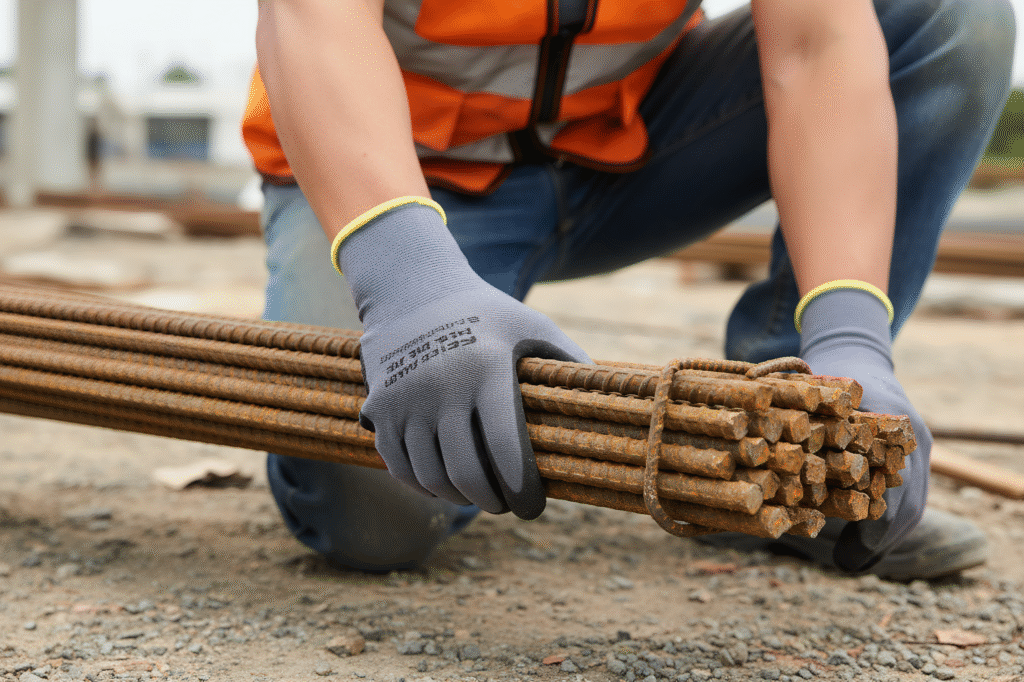
Your workers' hands are at risk, and gloves wear out too fast. This costs you money and downtime. You need a glove that consistently protects and lasts longer.
The key to controlling abrasion resistance is a multi-step process. It involves selecting high-quality polymers, adding reinforcement agents, precisely controlling the dipping and curing stages, and running strict quality tests. Each step is critical for a durable, protective final product.
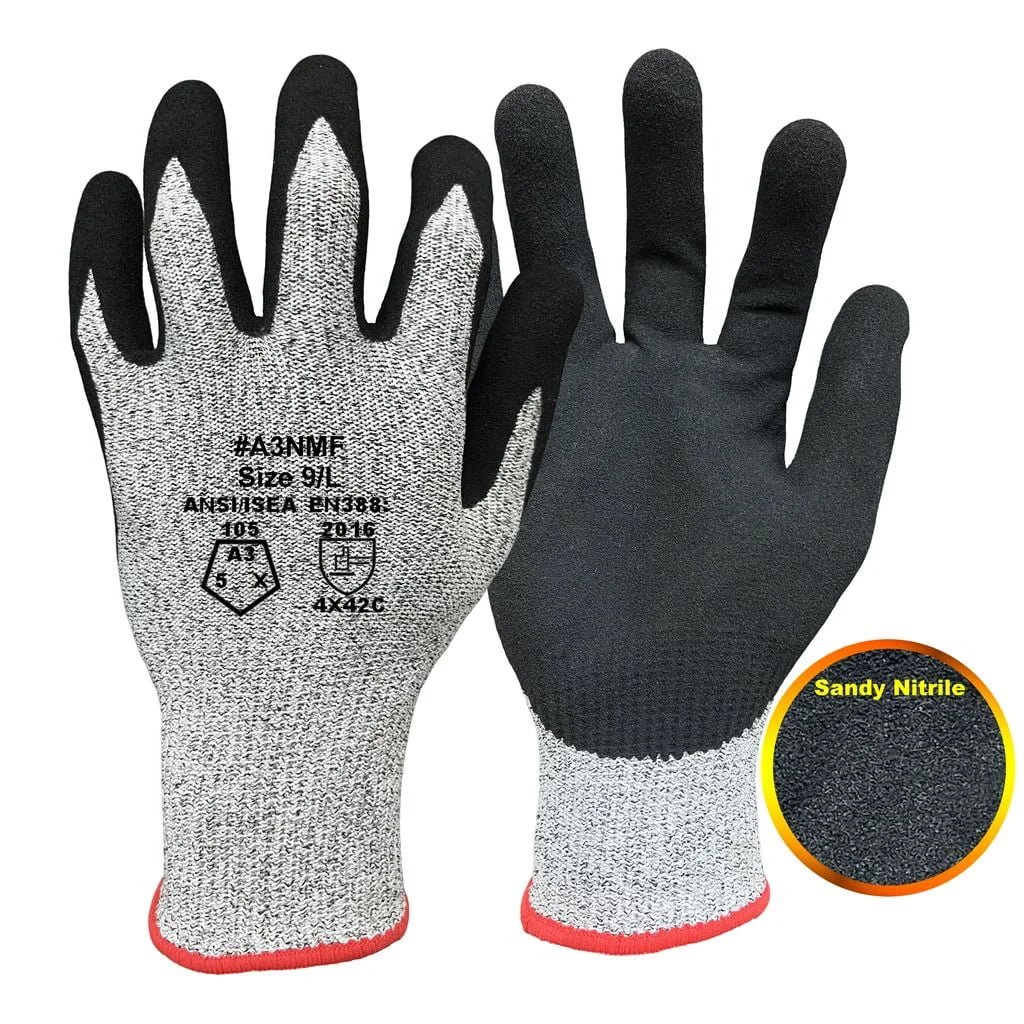
After more than 20 years of making safety gloves here at Antafursafety, I've seen firsthand how small details in production make a huge difference in performance. It's not about a single secret trick; it's about mastering every stage of the manufacturing process. If you're a purchasing manager or brand owner, understanding these steps helps you ask the right questions and choose a supplier who truly delivers on quality. Let's break down how we ensure our gloves meet the highest standards for abrasion resistance, from raw materials to the finished product.
Why Does Your Choice of Polymer and Additives Matter So Much?
Choosing the wrong materials leads to gloves that fail quickly. This means unhappy workers and rising replacement costs. You need a glove built from the right stuff from the very start.
The base polymer—like nitrile, latex, or polyurethane—sets the foundation for durability. We then mix in specific additives to enhance toughness and wear resistance, creating a compound engineered for high performance and a long life.

The journey to a highly abrasion-resistant glove begins with the core ingredients. Think of it like baking a cake; the quality of your flour and sugar determines the final result. In our world, the "flour" is the base polymer. Each one has its own strengths. We choose the polymer based on the glove's intended use. For us at Antafursafety, this is a critical decision.
Selecting the Best Base Polymer
The initial choice of polymer is everything. It defines the glove's core characteristics.
- Nitrile: We often use nitrile for its excellent resistance to oils, fuels, and certain chemicals. It’s also very tough and resists punctures and abrasion well.
- Natural Latex: This polymer offers fantastic elasticity and comfort. While strong, we often enhance its durability for heavy-duty tasks.
- Polyurethane (PU): PU is known for providing great dexterity and a strong grip without being bulky. It has good abrasion resistance for its thinness.
The Power of Smart Additives
Once we select the base polymer, we enhance it with additives. These are like supplements that make the coating even stronger. We add materials like silica or carbon black, which act as reinforcing agents. They integrate into the polymer structure and make it much tougher. We also use cross-linking agents, which help form a stronger chemical bond within the coating during the curing process. This creates a dense, durable network that is much harder to wear down.
| Polymer | Key Strength | Common Use Case |
|---|---|---|
| Nitrile | Oil & Puncture Resistance | Automotive, Metal Fabrication |
| Latex | High Elasticity & Comfort | General Handling, Janitorial |
| PU | Dexterity & Tactile Sense | Assembly, Electronics |
How Do Dipping and Curing Define Glove Durability?
A glove with an uneven or poorly bonded coating will wear out in spots and fail. This creates weak points and puts users at risk. You need a perfectly applied, fully cured coating.
A controlled dipping process applies multiple thin layers for uniform coverage. Then, precise curing at the right temperature and time fully hardens the polymer, locking in its strength and maximizing the glove's abrasion resistance.

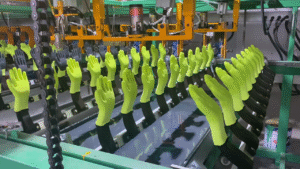
Having the right chemical mix is only half the battle. How you apply it and lock it into place is just as important. Over my years in this business, I've learned that the dipping and curing stages are where a glove's potential is either realized or lost. At our facility, with 3 polyurethane lines and 6 nitrile/latex lines, we have refined this process down to a science.
The Art of Controlled Dipping
You might think a single thick coat is stronger, but the opposite is true. A thick coat can be uneven and is more likely to have hidden weak spots. We use a method of applying multiple thin layers.
- Uniform Coverage: Each thin dip ensures the coating spreads evenly across the entire glove liner without pooling or dripping. This eliminates thin spots that would wear out first.
- Stronger Bond: Each layer bonds securely to the one before it and to the liner itself. This multi-layer structure is more flexible and resilient against daily friction and stress. Our daily output of over 20,000 dozen pairs relies on this precision.
The Science of Perfect Curing
After dipping, the gloves move into ovens for curing. This isn't just about drying them. Curing is a chemical process where heat activates the cross-linking agents we added earlier. These agents create a powerful network of bonds within the polymer. If the temperature is too low or the time is too short, the coating won't fully harden. If it's too hot or too long, it can become brittle. We follow strict ISO 9001 protocols to control temperature and duration perfectly, ensuring every glove reaches its maximum toughness and meets standards like EN 388.
Can the Liner and Surface Texture Really Boost Abrasion Resistance?
A great coating on a weak foundation is a waste. If the liner stretches or the surface is too smooth, the glove will fail early, no matter how good the coating is.
Yes, absolutely. A tightly knitted liner made from strong yarn like nylon or polyester provides a stable base. A textured surface, like a sandy or micro-foam finish, reduces friction and improves wear resistance.
The final pieces of the puzzle are the parts of the glove you can see and feel: the inner liner and the outer texture. These features are not just for comfort or grip; they play a huge role in the overall durability and abrasion performance. We operate 400 knitting machines for a reason—the liner is the backbone of the glove.
The Foundation: A High-Quality Liner
The coating needs a solid base to adhere to. A weak or loose liner will stretch and move under the coating, causing the coating to crack and peel away.
- Material Choice: We typically use strong, synthetic yarns like nylon and polyester. These materials resist stretching and provide a stable structure for the coating to bond with.
- Knit Density: Using our 13, 15, or 18-gauge knitting machines, we create a tight, dense fabric. A higher gauge means more stitches per inch, resulting in a less stretchy and more supportive liner. This stability is crucial for preventing premature coating failure during hard use. Our daily capacity of 10,000 dozen pairs of liners ensures we control this quality from the very first thread.
The Finish: Smart Surface Textures
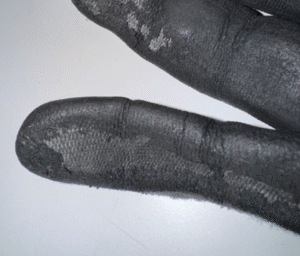
A completely smooth surface has more direct contact with abrasive objects, causing it to wear down faster. By engineering the texture, we can significantly extend the glove's life.
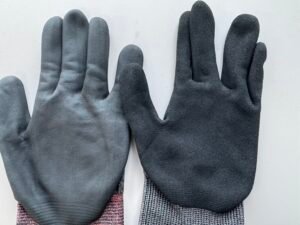
- Micro-Foam/Foam Finishes: These create a sponge-like surface that absorbs friction and provides an excellent grip in wet or oily conditions. The porous structure helps dissipate force across the surface.
- Sandy/Micro-Rough Finishes: We create these by embedding granules into the final coat. This sandpaper-like texture reduces the surface area in direct contact with objects, meaning the glove "glides" over rough surfaces rather than being worn down by them. This design dramatically improves abrasion resistance.
Conclusion
Controlling abrasion resistance is a total process. It requires quality materials, precise dipping and curing, and a smart design for the liner and surface. Each step adds to a stronger glove.